 Summary of this article Summary of this article
- The App-Based delivery is not just a logistics innovation but a labour regime that compresses time, erases safety margins, and pushes workers into risk-taking behaviour
- The failure of delivery-worker strikes reveals a structural shift that platform work is designed to neutralise collective action and worker organization.
- Gig workers are formally excluded from social security, insurance, and labour protections, With this model, where productivity is detached from rights, activists says India is sleepwalking into a future of work stripped of rights
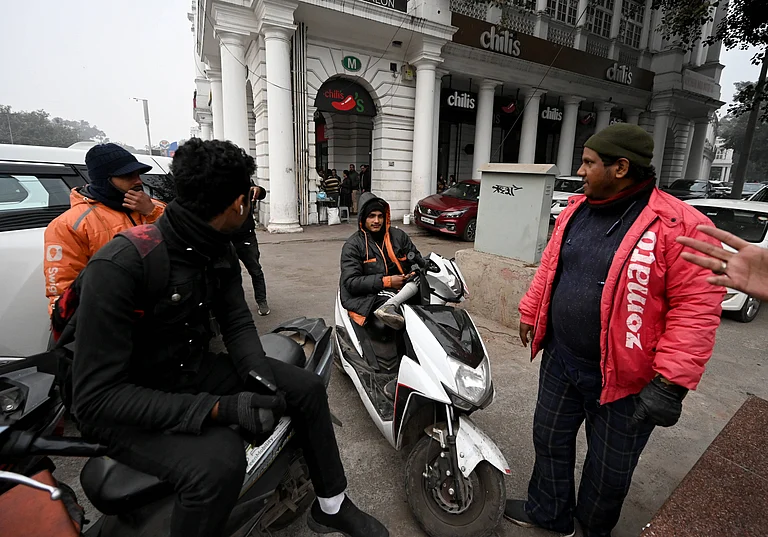
At 10:15 pm, Bhupendar, a 36-years-old delivery rider accelerates through a traffic red light at New Friends Colony in India’s national capital Delhi. His phone vibrates again. “Delay risk: order at 7 minutes.” His heart skips a beat. He has already crossed two red-lights without slowing down. The app does not tell him to break traffic laws, but it does not need to.
The countdown clock does the work. Bhupendar is delivering groceries promised in ten minutes—a guarantee he did not make, for a speed he does not control, under risks he alone must bear. For the order, he will earn Rs. 27. The app’s incentive chart flashes bonuses for “high efficiency,” penalties for cancellations, and complete silence on what happens if he is hit by a car. There is no insurance card in his wallet, no paid sick leave to fall back on, no union office to call if something goes wrong.
By the end of his shift—nearly thirteen hours—he has delivered groceries faster than any kirana shop ever could. He has also skipped meals, ignored a growing pain in his knee, and driven in ways he knows are unsafe. Tomorrow, he will log in again.This is what work looks like in the ultra-fast service delivery model in which labour is infinitely replaceable. As part of a faceless crowd working in the gig industry Bhupender had to surrender his individual rights when he chose to work as a delivery agent. It was not as if there was much option. With increasing unemployment, this was the last resort. India’s quick-commerce market grew from a marginal segment pre-2020 to an estimated $5–6 billion market by 2025, driven largely by 10–15 minute delivery promises. Despite revenue growth, per-order payouts for delivery workers have either stagnated or declined in many cities since 2022, according to worker collectives and platform pay screenshots.
[url=]Related Content[/url]
 Opinion | Gig Workers Need More Protection: Analysing The New Years' Strike Opinion | Gig Workers Need More Protection: Analysing The New Years' Strike
 Gendering The Workplace: Why Female Employment Matters Gendering The Workplace: Why Female Employment Matters
 'Rights On Paper, Not In Life': Workers Protest Labour Codes 'Rights On Paper, Not In Life': Workers Protest Labour Codes
 SKM Rejects New Labour Codes, Calls Claims of Worker Protection 'Unsubstantiated' SKM Rejects New Labour Codes, Calls Claims of Worker Protection 'Unsubstantiated'
[url=]Related Content[/url]
Opinion | Gig Workers Need More Protection: Analysing The New Years' Strike
Gendering The Workplace: Why Female Employment Matters
'Rights On Paper, Not In Life': Workers Protest Labour Codes
SKM Rejects New Labour Codes, Calls Claims of Worker Protection 'Unsubstantiated'
A Strike That Didn’t Matter
On December 31st, 2025 he along with tends of thousands of delivery workers participated in a strike, demanding higher per-order pay, accident coverage, and limits on algorithmic penalties. The strike barely registered. Orders continued to move. New riders logged in. Customers noticed nothing. Social media posts circulated urging riders to log out en masse. The platforms barely flinched.Orders continued to be fulfilled. The apps sent notifications offering temporary incentives to those who stayed logged in. A steady supply of new workers—many recently unemployed or underemployed—filled the gaps.India’s ultra-fast delivery boom has been sold as innovation. Ten-minute groceries, instant commerce, hyperlocal logistics—these are presented as triumphs of technology and efficiency. Companies like Zepto, Blinkit, and Swiggy’s Instamart have turned speed into a brand promise, competing not just on price or selection but on how quickly goods can materialise at a customer’s doorstep.What is less discussed is that speed in such a service delivery model is not simply a technical achievement. It is an organising principle for labour. Ten-minute delivery compresses time in ways that fundamentally alters working conditions. Warehouses are placed closer to residential areas. Inventory is algorithmically optimised. Routes are calculated to the second. Every delay—traffic, weather, fatigue, injury—is treated as a personal failure of the worker rather than a structural constraint. It normalizes working conditions which are risky and dangerous and offers nothing in return to the delivery worker.
Life Inside the Timer
For delivery workers, the economics are unforgiving. Pay is calculated per order, with small incentives layered on for completing a certain number of deliveries within a fixed time window. Fuel costs, vehicle maintenance, mobile data, and protective gear are borne entirely by the worker.A delivery rider in Noida describes the system bluntly: “If you slow down, you lose money. If you rush, you risk your life. Either way, the app wins.”Algorithmic management replaces human supervision. Workers receive automated warnings for “inefficiency,” their ratings fluctuate without explanation, and penalties are imposed with no appeal mechanism. A low rating can mean fewer orders. Fewer orders mean less income. There is no formal termination letter—only a gradual disappearance of work. |





