When Finance Minister Nirmala Sitharaman rises in Parliament on 1st February to present the Union Budget for FY2026-27, one of the most consequential battles being waged quietly outside the House will be over something few citizens ever see: data centres.
These vast warehouses of servers that are hungry for power, capital and cooling have become the backbone of India’s digital economy, and increasingly, the foundation of its artificial intelligence (AI) ambitions. As AI adoption accelerates across industries, technology leaders say the country’s ability to innovate at scale will depend not just on talent or algorithms, but on whether India can build affordable, sovereign digital infrastructure fast enough.
Encouraging Sovereign Compute
Sunil Gupta, Co-founder, CEO and MD at Yotta Data Services, frames the challenge in stark terms. “As AI adoption accelerates across sectors, India’s ability to innovate at scale will depend on the depth and affordability of its digital infrastructure. Sovereign, high-performance compute has become an important requirement to ensure that Indian enterprises, startups, and researchers can build, train, and deploy AI within the country and compete globally.”
The government has already signalled its intent through initiatives such as the IndiaAI Mission, which seeks to scale compute, platforms and talent in parallel. But industry leaders say the upcoming budget will determine whether that ambition translates into execution. Gupta believes targeted fiscal intervention could sharply reduce the cost of AI deployment.
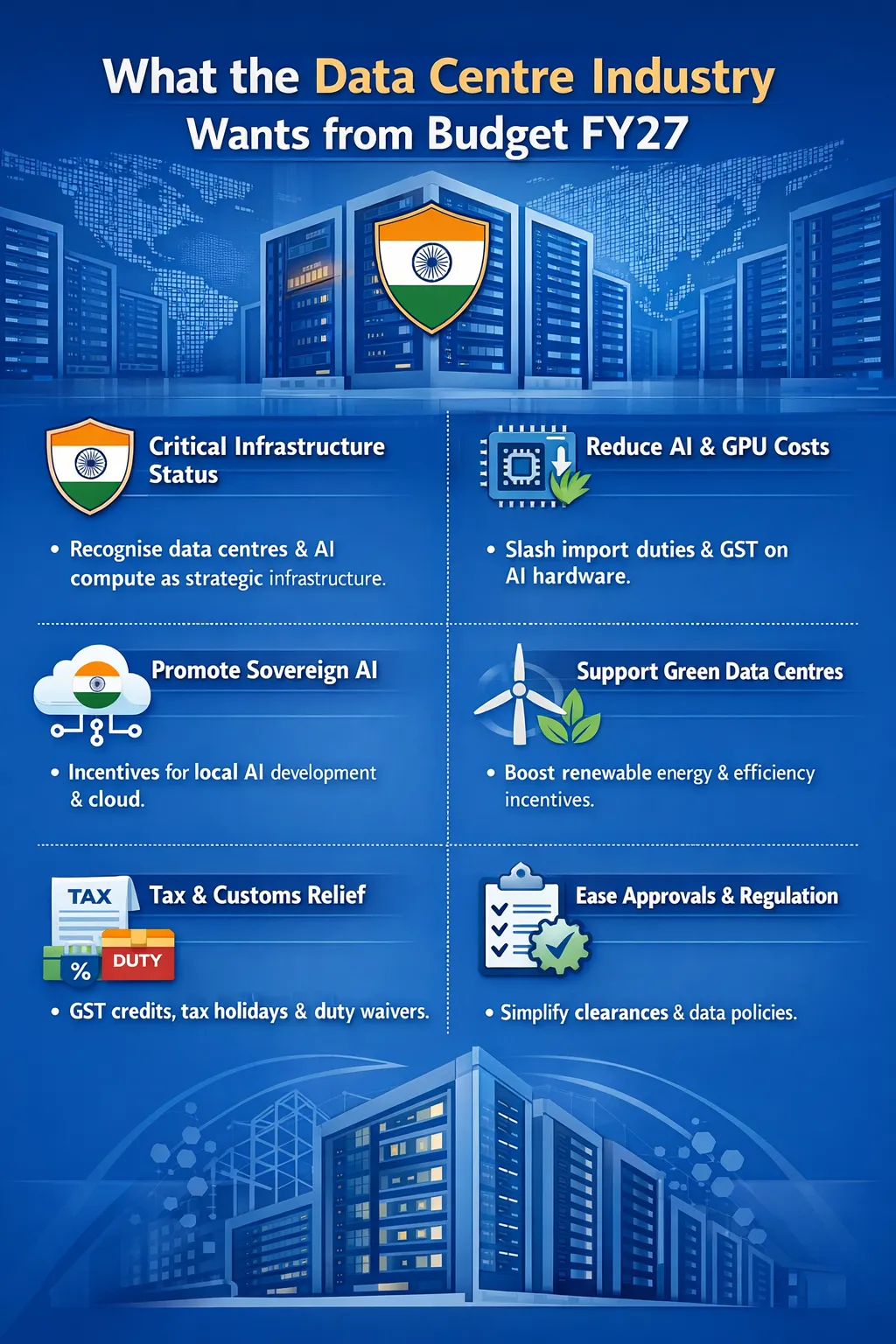
“A sharper fiscal push towards sovereign AI and data centre infrastructure, rationalisation of import duties on GPUs and critical hardware, and easing GST on AI and cloud services can significantly lower the cost of deployment.”
‘Strategic Infrastructure Status’
Behind the push is a deeper change underway in how enterprises view digital infrastructure. A S Rajgopal, CEO and MD at NxtGen Cloud Technologies, says data centres are no longer judged by size alone.
“Enterprises today are no longer asking how much capacity is available, but how infrastructure decisions align with capital efficiency, regulatory certainty, and long-term business resilience.”
As AI-led workloads become mainstream, Rajgopal says technology planning is increasingly co-owned by CIOs and CFOs, with hybrid and sovereign architectures now deliberate choices rather than abstract concepts.
“Hybrid and sovereign architectures are no longer debated concepts but deliberate design choices, driven by compliance requirements, latency sensitivities, cost optimisation, and risk management considerations.”
With India’s data centre capacity projected to grow nearly five-fold by 2030, industry executives argue that Budget 2026 must formally recognise data centres as strategic national infrastructure, on par with highways or power grids to ensure regulatory clarity and sustainable investment.
For some, the stakes are even more immediate. Anil Nama, CIO of CtrlS Datacenters, says India’s AI readiness is constrained by infrastructure long before it is limited by software.
“Union Budget 2026 should decisively strengthen India’s AI readiness by enabling AI-scale digital infrastructure. Targeted fiscal incentives for AI factories, GPU compute and high-density data centres along with formal recognition of data centres as critical infrastructure will enhance digital.”
The Sustainability Squeeze
The expansion, however, is not without friction. Power availability, renewable sourcing and environmental compliance are being mentioned as the next set of bottlenecks across the data centre industry.
Pinkesh Kotecha, Chairman and MD at Ishan Technologies, points to the scale of the challenge ahead. “India’s data centre capacity is expected to expand substantially through 2026 and beyond, driven by cloud migration and AI-led demand,” he says, noting that Asia-Pacific capacity is projected to rise from 32 gigawatts to 57 gigawatts by 2030.
Such growth, Kotecha says, will require policy support that goes beyond capacity creation.
“Sustainable operations, including low-power servers, advanced cooling systems and clean energy sourcing, must be supported through incentives and collaborative government-industry frameworks.”
Chips, Capital And The Sovereignty Question
For Narendra Sen, Founder and CEO at RackBank and NeevCloud, the most critical constraint lies at the heart of AI itself: chips. “Budget 2026 must prioritise granting infrastructure status to AI chips, enabling the sector to access long-term capital from financial institutions,” Sen says, warning that geopolitical tensions and tariff complexities threaten India’s ambitions.
“While we have the talent in research and startups to drive innovation, the availability and cost of chips remain the most critical bottlenecks that the government must address.”
Sen has also called for a production-linked incentive (PLI) framework that prioritises indigenous cloud platforms, arguing that digital sovereignty cannot be achieved if core compute infrastructure remains dependent on foreign hyperscalers.
What Deloitte Wants The Budget To Fix
Many of the industry’s demands find a more detailed and structured mention in Deloitte’s pre-Budget booklet, which argues that India’s data centre challenge is no longer incremental, but systemic.
“As new sectors such as digital infrastructure (data centres, fibre, towers) emerge in response to the rise of AI and data sovereignty, they will need clear policy interventions and focused reforms to ensure investments are appropriately incentivised,” Deloitte said.
The consulting firm pointed out that while India generates over 15 per cent of the world’s data, it accounts for under 5 per cent of global data centre capacity, a mismatch it described as unsustainable in an era of AI-led growth, automation and digitisation of citizen services. Meeting this demand, Deloitte said, will require a large, time-bound buildout of data centres, fibre networks, telecom towers and related infrastructure, backed by faster approvals and domestic manufacturing incentives.
“To assist in developing a large digital infrastructure, the government should re-examine the current policies and approval process, streamlining the permits required for such projects,” Deloitte said, adding that it was equally important to identify key components needed to build this infrastructure and incentivise their production in India.
At the core of Deloitte’s recommendations is a push to explicitly enable India’s data sovereignty and AI data centre infrastructure through targeted fiscal measures. Among its key asks is allowing full GST Input Tax Credit or GST refunds on data centre capital assets, including construction and electrical systems, along with time-limited GST relief on land and built structures for new data centre parks.
Deloitte also proposed a long-term tax framework to attract patient capital, calling for “about a 20-year conditional tax holiday for qualifying data centre developers,” with eligibility linked to capacity thresholds, employment generation and green energy targets.
To lower upfront costs during the industry’s scale-up phase, the firm recommended customs duty waivers on critical imported equipment such as racks, uninterruptible power supply systems, chillers and switchgear for an initial seven- to ten-year window, provided projects meet defined scale and sustainability criteria.
Beyond tax relief, Deloitte mentioned the need to directly seed AI development on domestic infrastructure. It proposed a compute-credit scheme that would provide time-limited free or discounted GPU and TPU hours to Indian startups, universities and research labs, allowing them to train AI models on India-based infrastructure and accelerate local AI product development.
Sustainability, Deloitte argued, must be embedded into incentives rather than treated as an afterthought. It recommended accelerated depreciation and GST input-tax credit eligibility only for data centres that commit to verified power usage effectiveness benchmarks, PUE of 1.4 or better, alongside progressive renewable energy procurement targets, such as sourcing at least 50 per cent renewable power within five years. Incentives, it said, should be phased out if these targets are missed.
The firm also proposed interest subvention of 3-4 per cent through a national infrastructure bank for data centre projects that procure at least 50 per cent renewable power and implement advanced measures such as waste-heat recovery or low-water cooling pilots.
In addition, Deloitte called for capital grants ranging from 25 to 35 per cent on eligible green capital expenditure, including heat recovery systems, free cooling, closed-loop cooling, on-site battery storage and modular UPS, for new Tier III and Tier IV data centres that meet defined energy and water-use targets. For emerging technologies, it proposed even higher support, including a 40 per cent grant for pilot projects using liquid cooling, direct-to-chip cooling, air-side economisers and closed-loop wastewater reuse in data centre parks.
To accelerate adoption of high-efficiency equipment, Deloitte also recommended a temporary waiver of duties on advanced chillers, in-rack cooling systems and modular power equipment procured for certified green data centres.
Finally, the firm asks the government to back sustainability with enabling infrastructure, calling for budgetary support for interstate renewable energy links and battery energy storage systems to ensure round-the-clock clean power for data centre clusters, alongside priority right-of-way for fibre and renewable transmission. It also recommended making compliance with the Bureau of Energy Efficiency’s data centre guidelines and public disclosure of PUE a condition for receiving incentives, supported by quarterly performance dashboards.
 |





