India’s Global Capability Centre (GCC) leaders want the government to move beyond fragmented state-level policies and offer a clear national framework, targeted tax incentives and greater regulatory certainty in the Union Budget for 2026-27, to sustain long-term investment by global companies.
The country already hosts more than 1,800 GCCs employing over two million professionals, accounting for more than half of such centres worldwide, but industry leaders say the next phase of growth will depend on whether the budget signals a stable, long-term commitment to high-value engineering, AI and product-led work rather than cost-driven outsourcing.
“State-led GCC policies are a welcome development, but the current situation is creating uncertainty for global enterprises that plan India GCC investments over a long-term horizon,” said Lalit Ahuja, Founder and CEO at ANSR.
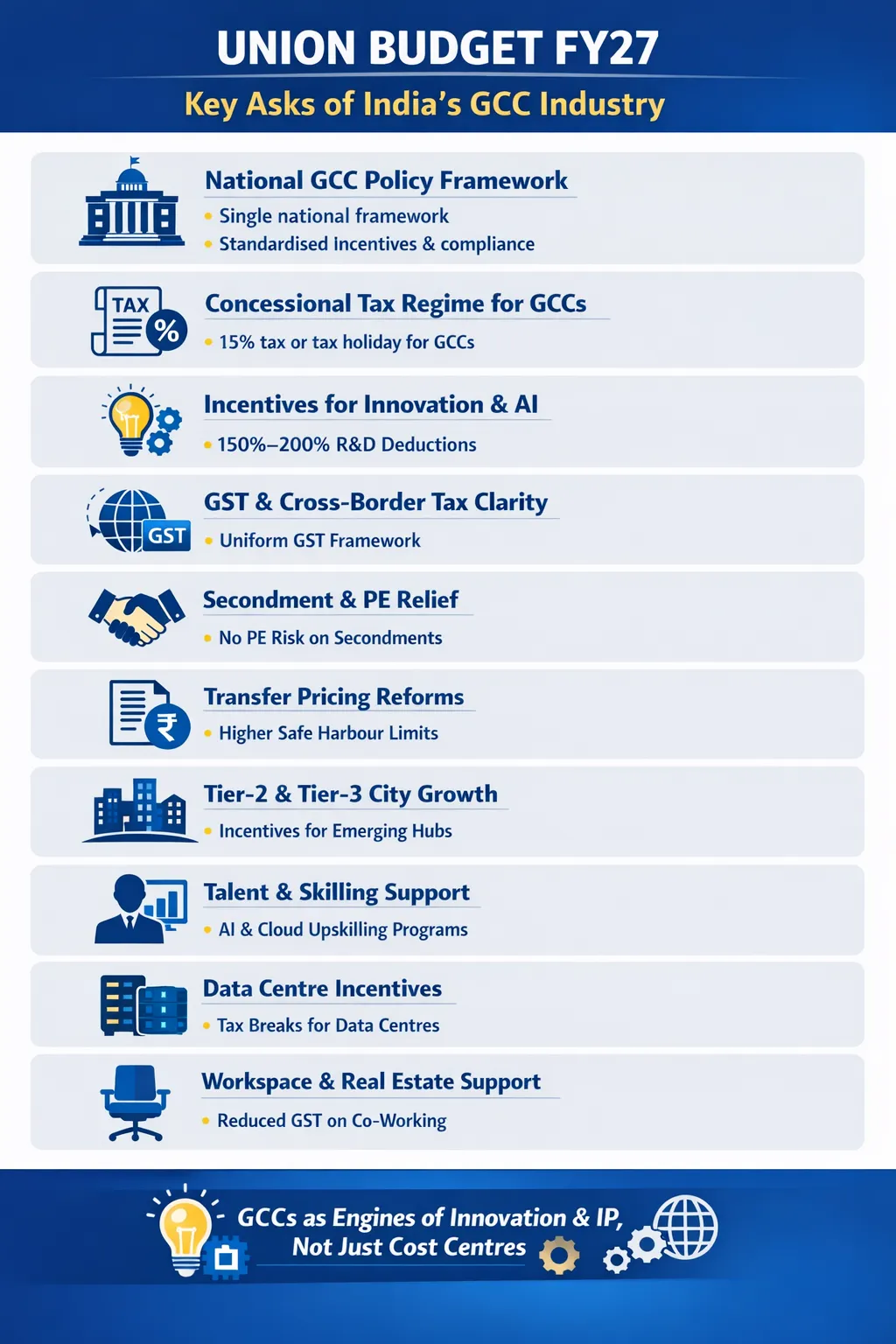
“What the GCC ecosystem now needs is a national GCC framework from the Centre, one that standardises definitions, offers baseline regulatory and tax clarity, enables single-window approvals, and aligns talent and skilling initiatives nationally,” he added, mentioning that while states should compete on execution and infrastructure, “a consistent national policy signal is essential to sustain investor confidence and accelerate India’s leadership as the world’s most strategic GCC hub.”
Push For Tax Competitiveness And IP Creation
At the heart of industry demands is a call for tax measures that support intellectual property creation, research and development, and advanced engineering work being carried out in India.
“For India to convert its strong GCC momentum into sustainable, long-term global investments, the Union Budget must address predictability, competitiveness, and talent-enablement,” said Ahuja.
He called for “a clear nationwide tax incentive for GCCs,” GST clarity on cross-border services, incentives for workforce upskilling in AI and data sciences, and capital expenditure support to expand GCCs into Tier-2 and Tier-3 cities.
Professional services firm Deloitte, in its budget representation, has asked the government to introduce a concessional tax regime for GCCs, including “a concessional corporate tax rate (e.g., 15 per cent) or a tax holiday for newly established or expanding GCCs, similar to the benefit previously provided to new manufacturing units under Section 115BAB.”
Deloitte said such a regime should define clear eligibility criteria linked to incremental employment, new investment and export revenue, while allowing flexibility for GCCs transitioning from cost-plus service models to innovation-led structures.
“A concessional regime signals a strong policy intent to position India as a delivery destination and as an innovation and decision-making hub,” Deloitte said, adding that it would align India with global tax competitors such as Vietnam and the Philippines and help attract investment in R&D, AI and product engineering.
The firm has also sought weighted deductions of 150-200 per cent on eligible R&D and technology spend, accelerated depreciation for digital infrastructure and AI platforms, and inclusion of IP creation and global product engineering under eligible activities.
GST, Secondment And Transfer Pricing Concerns
Beyond incentives, industry bodies and advisors have focused on the need for clarity to reduce disputes and compliance burdens.
Deloitte has urged the government to provide explicit guidance on the taxation of employee secondment and cost-sharing arrangements, seeking clarity that bona fide secondments would not create a permanent establishment or trigger fee-for-technical-services classification.
“Secondments are integral to GCC operations, enabling knowledge transfer and global skill alignment,” Deloitte said, warning that inconsistent assessments deter companies from expanding global roles in India.
Industry body Nasscom echoed these concerns, saying cross-border secondment arrangements in IT and GCCs have “historically faced prolonged tax litigation in India,” with authorities often arguing that such arrangements create a permanent establishment or attract withholding tax under fee-for-technical-services provisions.
“This creates unnecessary compliance burdens and financial strain especially in IT/ITeS sector and GCC space where there are multitude of cross border secondment arrangements,” Nasscom said, recommending legislative amendments to avoid double taxation and excessive expense disallowances linked to procedural delays in tax deduction.
Deloitte has also called for reforms in transfer pricing, including rationalising safe harbour margins, raising transaction thresholds beyond the current Rs 300 crore, fast-tracking advance pricing agreements for certified GCCs, and supporting India’s participation in multilateral tax certainty programmes.
Tier-2 Cities, Talent And Infrastructure
While the 2025 budget announced a national framework to promote GCCs in emerging locations, industry leaders say execution has been uneven.
“We are seeing early traction in select Tier-2 locations, but global enterprises still face challenges around talent depth, infrastructure readiness, and policy predictability at scale,” Ahuja said, calling for targeted incentives, shared infrastructure investments and harmonised compliance across states.
Deloitte has recommended tax sops for GCC employees in Tier-2 and Tier-3 cities to encourage talent mobility, while also seeking clarity on employee stock option taxation for globally mobile staff to avoid double taxation.
On infrastructure, Deloitte has sought targeted tax incentives for data centres, including concessional tax rates or weighted deductions for capital expenditure, calling data centres “the backbone of the digital economy” and critical for AI, cloud services and data localisation.
Flexible workspace providers have also pitched for policy support. “A reduction of GST on co-working services from 18 per cent to 12 per cent or lower, along with enabling full input tax credit on fit-outs and operating expenses, would improve cost efficiency and deployment timelines,” said Sanjay Chatrath, Co-founder and Managing Partner at Incuspaze.
He added that granting formal industry status to managed workspaces and accelerated depreciation for interiors and digital infrastructure would strengthen India’s distributed office ecosystem.
Long-term Signal Sought
Executives say the upcoming budget needs to go beyond incremental measures and send a strong signal to global companies evaluating India as a long-term GCC destination.
“As India deepens its role as a global hub for Global Capability Centres, Budget 2026 presents an important opportunity to reinforce global confidence through greater policy clarity,” said Monica Pirgal, CEO at Bhartiya Converge. “Continued progress on permanent establishment guidance, more predictable safe-harbour frameworks, and fiscal incentives for GCCs, along with high-value digital and AI-led capabilities, can provide better ROI for long-term GCC investments.”
From a real estate and urban development perspective, Aditya B. Yamsanwar, Director at Team One Architects, said the shift beyond metros requires deeper integration with city planning.
“To make non-metro talent truly GCC-ready, Budget 2026 must pivot from intent to execution by enabling urban-scale development—planned business districts, ESG-compliant Grade-A offices, mobility, housing and ecosystem anchors that create employment density,” he said.
 |





