With India still absorbing the debates from the fifth day of the India AI Impact Summit 2026, Roy Jakobs landed in Bengaluru in the early hours of Friday, after attending the summit and a global CEO roundtable. For the CEO of Royal Philips, the discussions in New Delhi had only sharpened a belief he has articulated for years: healthcare will feel AI’s impact sooner, and more intensely, than almost any other industry.
Speaking with BW Businessworld, Jakobs said that this conviction of his does not come from technological exuberance but from demographic arithmetic. The global demand for care is rising relentlessly, even as the systems meant to deliver it are thinning out.
“The world is still getting sicker,” Jakobs said. “Patients are ageing, diseases start earlier and more complex. We treat them longer too.”
What makes this moment different, he said, is that the human buffer healthcare once relied on is eroding. Hospitals across continents are facing shortages of doctors, nurses, technicians and specialists. Burnout is accelerating attrition. Talent is being pulled across borders. As a result, the pipeline of trained professionals cannot keep pace.
“You don’t have enough doctors. You don’t have enough specialists. You don’t have enough nurses,” Jakobs said. “That creates a pressured situation, because people burnout and then care gets even worse.”
In India, the doctor-to-population ratio is at 1:811 and out-of-pocket health expenditure is approximated to be at about 40 per cent. AI-enabled diagnostics, triage and predictive analytics can expand clinical capacity, as per a white paper by Prosus, BCG and the Ministry of Electronics and Information Technology (MeitY).
Why Healthcare Will Move Faster Than Other Industries
Unlike manufacturing or retail, where automation often triggers anxiety about job displacement, healthcare faces the opposite problem: there simply are not enough people.
“This (AI) will not replace people,” Jakobs said. “We just don’t have enough radiologists. We don’t have enough pathologists.”
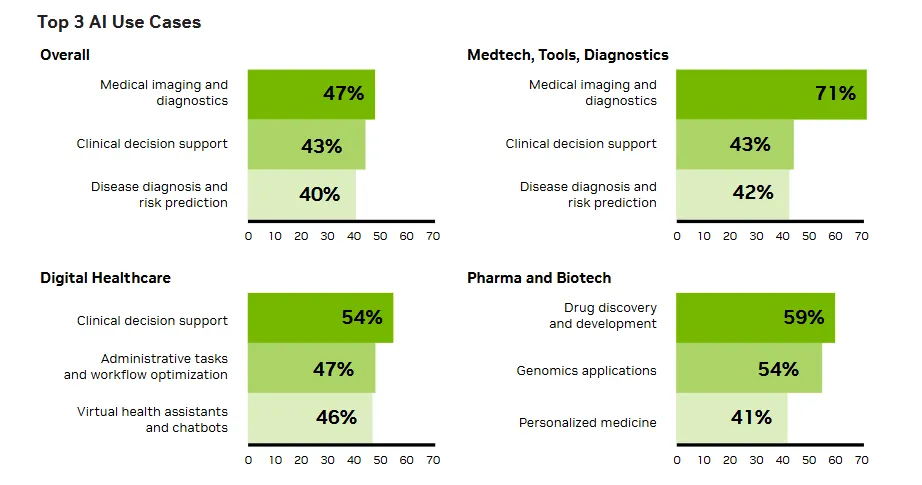 Top AI use cases in healthcare globally (2025) | Source: Nvidia’s State of AI in Healthcare and Life Sciences: 2025 Trends Top AI use cases in healthcare globally (2025) | Source: Nvidia’s State of AI in Healthcare and Life Sciences: 2025 Trends
For Philips, this shortage has apparently reframed the purpose of innovation. The goal is no longer just better machines or faster software, but systems that allow fewer clinicians to deliver more care without compromising safety or quality.
“This has to happen because it can help people,” Jakobs said. “That’s why adoption will move faster.”
As per India Brand Equity Foundation (IBEF), India’s health-tech sector is projected to reach Rs 4,43,500 crore (USD 50 billion) by 2033, driven by the adoption of AI and automation to enable faster insurance claim decisions and more data-driven underwriting.
Philips’ own evolution points to this shift. For decades, the company pushed the boundaries of healthcare hardware by building imaging systems, scanners and clinical devices. Then, over the past twenty years, software became central. Now, AI is reshaping the entire stack.
“AI helps solve problems we’ve always had, but now they’ve grown bigger because of scale,” Jakobs said.
India’s Strategic Role In A Global Bet
This AI-led transformation is increasingly anchored in India. Over the past six years, Philips has invested EUR 175 million in the country, primarily across Bengaluru and Pune, building innovation hubs, R&D centres, and manufacturing capacity. According to its annual report 2025, the company employs 8,150 people in India, many of them engineers whose work now feeds directly into Philips’ global healthcare portfolio, which contributes over 75 per cent in company’s overall sales (EUR 13.6 billion in 2025).
“India is a native software country,” Jakobs said. “India breeds software.”
More than half of Philips’ global software development now happens in India, and a growing share of its AI algorithms are either developed or co-developed here, often in collaboration with local hospitals and clinical partners.
Yet software alone is not enough. AI, Jakobs stressed, is only as powerful as the data behind it.
“You need big datasets to play with,” Jakobs said. “AI is as powerful as the quality of data you give the AI.”
Hospitals, in India and elsewhere, remain fragmented. Data sits siloed across departments, vendors and legacy systems, limiting AI’s ability to deliver meaningful insights, Jakobs explained. Philips’ strategy has been to focus on interoperability by connecting devices, platforms, and hospital systems so clinicians can see the full patient picture.
“If you don’t have the full patient view,” Jakobs said, “you miss very important information.”
Bengaluru To The World
Some of Philips’ most visible AI breakthroughs show how India’s engineering talent now shapes global healthcare.
One example is cardiac MRI imaging. Traditionally, complex cardiac scans could take up to an hour, an exhausting experience for patients and a bottleneck for hospitals.
“That’s way too long,” Jakobs said.
An AI algorithm co-developed in India cut scan times in half, reducing them from 60 minutes to 30. The technology is now being deployed globally, including in Japan, where Philips holds a leading position in MRI imaging.
“We’re now developing the next generation,” Jakobs said. “How can we bring it to 10 minutes? That’s what we are working towards.”
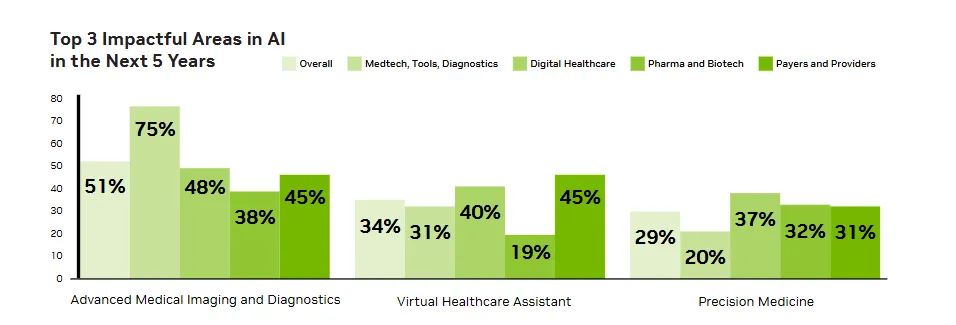 Top 3 areas in healthcare where AI will have most impact in next five years | Source: Nvidia’s State of AI in Healthcare and Life Sciences: 2025 Trends Top 3 areas in healthcare where AI will have most impact in next five years | Source: Nvidia’s State of AI in Healthcare and Life Sciences: 2025 Trends
The implications are substantial. Faster scans mean more patients treated, lower costs and better utilisation of existing equipment. All this without new capital investment.
“With just a software upgrade,” Jakobs said, “you can do 250,000 more scans with the same equipment.”
AI As A Tool For Democratisation
Advanced medical technology is often criticised for serving only those who can afford it. Jakobs says AI will flip that equation.
“I think it’s actually an excellent tool to democratise healthcare,” he said.
Philips’ handheld ultrasound device, Lumify, plugs into a tablet and uses AI to guide users through complex scans. Procedures like echocardiograms, once confined to hospitals, can now be performed in the field.
“The ASHA worker would actually be able to do a scan that you traditionally would go to a hospital for"
This approach may work well for India’s vast network of community health centres (1.8 lakh Ayushman Arogya Mandirs), where digitisation allows expertise to travel digitally, even when specialists cannot, he said.
“You don’t only treat people in hospitals,” Jakobs said. “Hospitals are expensive. You need to bring care closer to people.”
The same logic applies to high-end interventions. Stroke care, for instance, depends on rapid access to specialised interventional suites. In countries like Indonesia, Philips has helped build national networks where local facilities are supported by centralised command centres, helping make faster, life-saving decisions.
“If you do that in India,” Jakobs said, “you can deploy care at much larger scale.”
Application Over Abstraction
What struck Jakobs most at the India AI Impact Summit was not the country’s ambition, but focus. Jakobs recounted his exchanges with Prime Minister Narendra Modi and the Health Minister that went beyond broad vision statements and into questions of delivery. The emphasis, he said, was on how AI could help India extend care beyond hospitals and into communities.
“I wasn’t just seeing vision,” he said. “I was seeing people looking at application.”
India, he believes, has chosen its role in the AI race wisely by choosing to not just competing on foundational models, but by focusing on real-world deployment.
“We are in the application layer,” Jakobs said. “That’s where we play, which is in line with India’s AI goals.”
Philips operates across the AI ecosystem, working with cloud providers, chipmakers, and electronic medical record platforms, but concentrates on translating technology into clinical outcomes.
“That’s where the differentiation is,” he said.
Trust As The Final Frontier
As AI becomes embedded in healthcare, trust becomes non-negotiable. Here, Philips sees a strategic advantage.
“We are very trusted in India,” Jakobs said. “People believe in you, if you deploy AI and it’s done safely, effectively, and responsibly. And we take this trust seriously.”
That trust spans generations, from consumers who grew up with the Philips brand to Gen Z users adopting its newest products. It also underpins the company’s approach to responsible AI, which doubles down on validation, regulation and human oversight.
“AI must serve humans and be trusted,” Jakobs said. “That’s what Philips is focused on and everyone else must also work towards.” |





