Bhubaneswar
He holds a pair of bamboo splits in his left hand, while the right hand picks a paddy grain from the heap beside him, and gently sets it between the splits. Then he draws the thread of his chosen colour from the coil in front of him and weaves it around the grain. Again he places another grain between the splits and ties it with the first one. The process goes on for a week with intermittent breaks for breakfast, lunch and evening tea. Finally, a one-feet-high Lord Ganesh of paddy grains shapes up, ready for sale.
This is the paddy craftsmanship of Padaman Munda (29), a Bhotra by tribe. Lord Ganesh is just one of myriad gods and goddesses, animals and birds, figures and figurines that bear testimony to his paddy craftsmanship.
Hailing from Limbatta village of Nabarangpur, Odisha, Padaman inherited the skill from his grandfather. His wife, two brothers and parents, who also carry on with this craftsmanship, earn an erratic monthly income of about Rs 40,000 that includes Padaman’s lone contribution of nearly Rs 10,000.
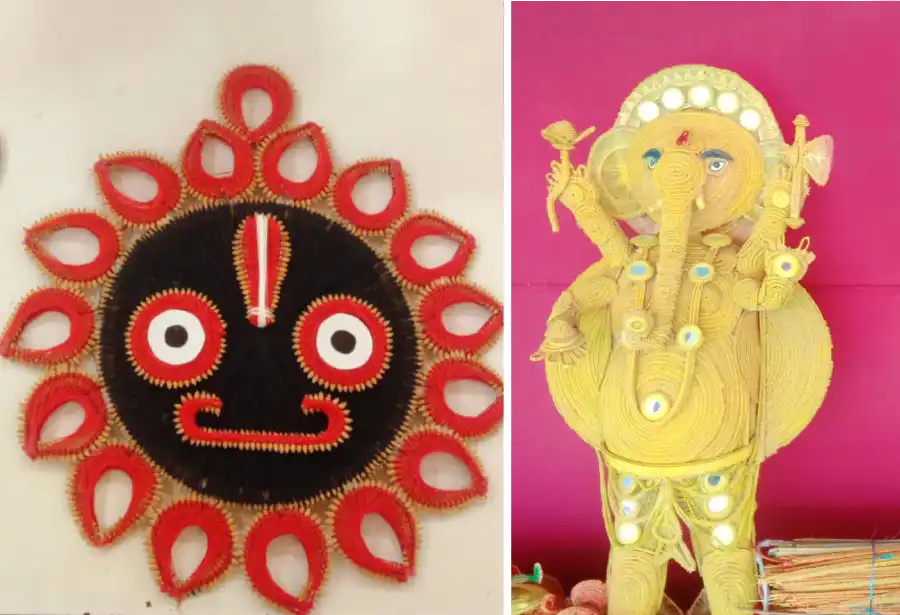
Several indigenous paddy varieties are used in the craft, but sapuri is Padaman’s favorite, as it is bigger in size and that makes his work easier. “I soak paddy in turmeric water before drying it in the sun for my work to take off. Turmeric water prevents bacterial attack and lends a glaze to paddy,” he said.
Padaman’s nimble hands weaves out 15 crafts every month on an average to add to over 40 that his family members create during the same period.
“He is faster and smarter than all of us. This is why Bhubaneswar-based State tribal museum has zeroed in on him for its requirement,” said Padaman’s wife Tulsi Munda.
Purusottama Patnaik, the tribal museum’s curator, lends credence to what Tulsi says about her husband. “Craftsmen who worked for us earlier were lax and lethargic, but Padaman is sincerely creative,” said Patnaik.

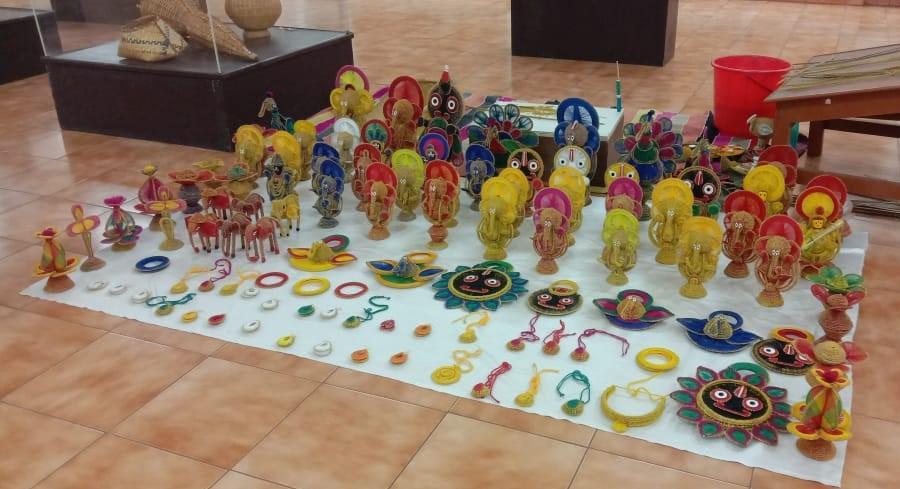
Padaman’s craft sells like hot cakes in his own village and its adjoining ones, particularly during festive occasions like Akshaya Tritiya, Bali Yatra and Diwali when the sale of his gods and goddesses shoots up by 10 per cent. “I also sell my items at different fairs including the annual Adivasi Mela in the state capital,” he said adding, “The price of each of craft varies between Rs, 300 and Rs 600. The height of the craft determines its price.”
When asked whether he or his family had received any government aid for the craft, he said, “We got Rs. 1.30 lakh from the State industry department in 2022 to set up our own house,” he said.
His deft hands churned out mini ear-rings, lockets, necklaces and rings along with small and large images of different deities that traditional craftsmen make.
But the real test for him came between 2013 and 2015, when he along with five craftsmen were invited to Manav Sangrahalaya, Bhopal and Regional Museum of Natural History, Mysore. While Padaman and his team created 12 images during their 10-day stay in Mysore, they made huge images of their three tribal deities—Jhangda Bhima, Raila Khanduri and Tengua Bhima—during their 21-day sojourn in Bhopal.
|





