Social Welfare
Posted On:
09 JUL 2025 11:20AM
"To develop our capabilities and talents, we must first pay attention to our fitness and well-being. Do you remember my suggestion for reducing obesity? Reduce oil in food by 10%, reduce excess weight. When you are fit, you will be superhit in your life," Prime Minister Narendra Modi assertedin his June 29, 2025, Mann Ki Baat address.
The Prime Minister called on people to reduce oil and unhealthy food consumption as part of adopting healthier diets to promote wellness and to address diet-related health problems. Various Government of India programmes have been successfully improving the food-related public health ecosystem over the years.
Seven years ago in July 2018, the Food Safety and Standards Authority of India (FSSAI) launched the Eat Right India initiative. The initiative focuses on promoting a culture of safe, healthy and sustainable food processes. Through a mix of regulatory, capacity-building, collaborative and empowerment approaches, the initiative has been enhancing the quality of food people consume daily — from when food is grown or sourced to when it is cooked and delivered to people's plates.
The campaign is built on three foundational pillars that address different aspects of India's food challenges:
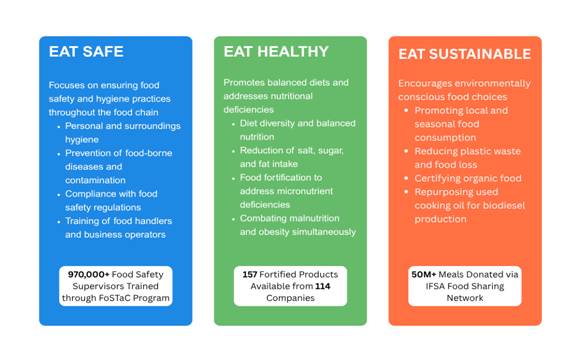
The wide-ranging initiative encompasses various schemes and programmes that have been recognised globally by the Rockefeller Foundation and the World Health Organisation for their innovative approaches. The food business industries and consumers across India have readily adopted the schemes and best practices, including hygiene ratings at food establishments and railway stations, repurposing of cooking oil, and training of food business operators. Since its inception, the Eat Right India initiative has been transforming the food ecosystem for better community health.
Modern lifestyles have brought about significant shifts in dietary patterns and food consumption. As a result, issues related to nutrition, lifestyle-related health conditions and food safety have gained increased attention. In India, a substantial proportion of health outcomes are now influenced by diet-related factors, including non-communicable conditions such as heart disease, diabetes, and hypertension.
These evolving dietary habits, along with the complexity of today’s food systems, have also brought food safety into sharper focus. Factors such as microbial contamination and chemical residues—from sources like pesticides, heavy metals, and additives—can impact the quality and safety of food. Regional data from the South-East Asia Region over past decades has highlighted the importance of maintaining food hygiene and safety standards, especially for vulnerable groups such as children, pregnant women, and older adults.
Taken together, the combined considerations of nutrition, lifestyle, and food safety point to the importance of encouraging balanced eating habits and strengthening systems that support safe, wholesome food for all.
In response, Eat Right India was launched by FSSAI as a comprehensive movement to ensure that food is not just safe, but also nutritious and environmentally sustainable. The initiative aims to empower citizens to make informed food choices, while encouraging food businesses to improve standards and reduce harmful ingredients.
More than just a government campaign, Eat Right India is building a people-first movement—where schools, workplaces, markets and communities all join hands to make healthy eating a shared habit. The goal is not just regulation, but transformation: of mindsets, behaviours and the entire food culture. It is a journey towards an India where everyone can access food that is not just filling, but nourishing and trustworthy.
At the core of the Eat Right India movement is a three-pronged strategy that addresses the food system holistically: improving supply-side standards, enabling informed consumer choices and advancing environmental sustainability.
Stop Obesity Campaign (2025): Union Health Minister J.P. Nadda launched FSSAI's "Stop Obesity" campaign on World Food Safety Day 2025 (June 7), calling for a nationwide 10% reduction in salt and oil consumption.
Microplastics Research Initiative (2024): FSSAI launched "Micro-and Nano-Plastics as Emerging Food Contaminants" project in March 2024, collaborating with CSIR-Indian Institute of Toxicology Research, ICAR-Central Institute of Fisheries Technology, and Birla Institute of Technology and Science to establish standard protocols and generate exposure data.
Eat Right Street Food Hub
Eat Right Station
Eat Right Campus
Eat Right Fruits & Vegetables Market
Eat Right Places of Worship
Eat Right School
Reduction of Fat, Sugar & Salt
Trans-fat Free India @75 by 2022
Fortification
Hygiene Rating
Combating Adulteration Jaivik Bharat
Save Food, Share Food
Safe Sustainable Packaging
Repurposed Used Cooking Oil
Other flagship programmes of the Eat Right Movement include:
Eat Right Initiative has already been recognised internationally for its vision, scope and approach.
The campaign was recognised as one of thetop visionaries in 2021for the 'Food Systems Vision Prize' by the Rockefeller Foundation for envisioning a regenerative and nourishing food system by the year 2050. The campaign was chosen from among more than 1,300 submissions from teams spanning 110 countries. The prize aims to enhance global discourse on food systems, empowering communities to devise actionable blueprints for their future.
The'SKOCH Platinum Award 2017’recognised FSSAI's Indian Food Sharing Alliance (IFSA) for addressing food waste and addressing the critical gap between food surplus and food insecurity through technological intervention, ultimately contributing to the donation of more than 50 million meals.
The “Heart Attack Rewind” campaign for eliminating trans-fat by 2022 in India reached 34.9 million people, including securing commitments from major industry associations such as Indian Vanaspati Producers’ Association and others.The World Health Organisationgave special mention to India as one of the 44 countries with best practices for eliminating trans-fats.
The success of the Eat Right India movement lies in its ability to bring diverse stakeholders together under a unified vision for food safety, nutrition and sustainability. Recognising that no single entity can drive systemic change alone, the initiative adopts a collaborative, whole-of-government and whole-of-society approach. From national ministries and state authorities to private companies, academic institutions, NGOs and citizen groups, a wide network of partners has been mobilised to translate policy into action. This multi-tiered engagement not only ensures stronger implementation but also fosters shared responsibility and collective ownership across India's complex food ecosystem.
1
Whole of Government Approach
2
Private Sector Participation
3
Public-Private Partnership
4
Other Institutions
Whole‑of‑Government engagementis the backbone of Eat Right India. FSSAI brings together key ministries—Health and Family Welfare, Women and Child Development, Housing and Urban Affairs, and Education—to align the initiative with flagship programmes like Ayushman Bharat, POSHAN Abhiyaan and Swachh Bharat Mission. At the state and local levels, Food Safety Departments and municipal bodies implement certification schemes, audits and community outreach in food hubs and municipal institutions.
The private sectorplays a pivotal role through partnershipsandCSR. Controlled voluntary collaboration with food businesses—ranging from major manufacturers to local street vendors—has led to product reformulation, improved hygiene ratings and certification at workplaces and campuses. The Corporate for Eat Right India (C4ERI) platform encourages private entities to support infrastructure, training and large-scale awareness activities such as the Swastha Bharat Yatra cyclothon.
Public‑Private and Third‑party collaborationsbolster capacity and reach. With more than 220 external training partners and 2,000+ certified trainers delivering FoSTaC modules, and laboratories supporting food testing via mobile labs (Food Safety on Wheels) and static labs like the National Food Laboratory, the initiative also establishes auditors and professional bodies to support hygiene benchmarking at scale.
Academic, Civil Society and development partnersanchor grassroots impact. Universities and professional bodies contribute to curriculum development for Food Safety Officers and Eat Right School modules. NGOs and consumer groups help tailor outreach for vulnerable communities, while development agencies offer technical guidance and evaluation tools—creating a participatory ecosystem designed to enable shared ownership and long-term behavioural change.

The Eat Right India initiative stands out for its strong alignment with both India's national development priorities and global commitments under the UN Sustainable Development Goals (SDGs). Rather than functioning in isolation, it complements and reinforces existing government schemes focused on health, nutrition, sanitation and sustainable development. By integrating food safety, nutrition awareness and environmental responsibility into a single movement, Eat Right India supports a whole-of-government, whole-of-society approach to systemic change—bridging efforts across ministries and sectors to create a healthier, more resilient nation.
SDG 3: Good Health and Wellbeing
Reduces burden of foodborne illnesses and diet-related non-communicable diseases
SDG 2: Zero Hunger
Addresses undernutrition and promotes fortified and wholesome foods
SDG 17: Partnerships for Goals
Fosters collaboration across government bodies, food businesses, academia, and civil society.
SDG 12: Responsible Consumption and Production
Encourages food waste reduction, sustainable food choices, and eco-friendly practices.
Globally, the initiative contributes directly to multiple SDGs:
At the national level, Eat Right India enhances the impact of several flagship programmes.
Poshan Abhiyan
Ayushman Bharat Yojana
Swachh Bharat Mission
Anemia Mukt Bharat
Aligns with Ayushman Bharat Yojana (Ministry of Health and Family Welfare) by promoting preventive healthcare through healthier diets and food environments.
Complements POSHAN Abhiyaan and Anaemia Mukt Bharat (Ministry of Women and Child Development and Ministry of Health and Family Welfare) by strengthening community-based nutrition efforts and addressing micronutrient deficiencies.
The initiative also supports the goals of the Swachh Bharat Mission (Ministry of Housing and Urban Affairs) by advocating for hygienic food practices and clean, safe eating spaces in public institutions and markets.
FSSAI's Eat Right India leverages cutting-edge digital infrastructure to reach India's diverse ecosystem. FoSCoS is a single-window digital platform that streamlines the licensing, registration and compliance management for lakhs of registered food businesses worldwide.
The Food Safety Connect mobile appcreates a real-time ecosystem to connect inspectors, consumers and businesses for instant reporting, compliance tracking and feedback.
Apart from the technological integration, the initiative uses grassroots human networks to reach consumers and businesses. The Food Safety Mitra programme exemplifies this approach—registering over 62,000 to bring last-mile compliance support to remote areas through digital platforms. From mobile food testing laboratories equipped with LED screens and vernacular training materials reaching remote villages to the FoSTaC system to the Jaivik Bharat portal (recording 1.4 million visits as of July 8, 2025), the campaign shows the human-centric approach of technological tools.
Since its launch, the Eat Right India movement has grown into one of the most expansive food safety and nutrition initiatives in the world. Backed by strong institutional frameworks and cross-sectoral collaboration, it has translated vision into impact through measurable outcomes on the ground. From transforming campuses and railway stations into certified “Eat Right” zones to training lakhs of food handlers, mobilising public participation, and enhancing hygiene across street food hubs and temples, the initiative stands out for its scale, innovation, and commitment to public health. The dashboard below captures some of the key milestones achieved under its various programmes.
In alignment with the Prime Minister'sappeal to all citizens to mobilise every individual and proactive action towards maintaining a healthy diet and fitness regimen; the Eat Right Initiative works to enhance the quality of food consumed by people across the food supply chain. The goal is to transform the food ecosystem in India through regulatory, individual, and community participation.
Click here to download PDF
******
RT/RK
(Explainer ID: 154849)
आगंतुक पटल : 6223
|





