Infrastructure
Posted On:
27 JAN 2026 5:18PM
Key Takeaways
India’s Energy Imperative in a Changing World
Energy is fundamental to economic activity, social development, and human well-being. It enables industrial production, transportation, agriculture, healthcare services, digital connectivity, and daily household needs. India, one of the world’s fastest-growing economies, is the third-largest consumer of crude oil, reflecting the continued importance of petroleum in mobility, logistics, and industrial activity. At the same time, India’s energy demand is projected to grow faster than almost any other major economy through 2035, and the country is expected to account for over 23 per cent of global incremental energy demand by 2050, the highest for any country.
In order to meet this growing demand, India has focused on strengthening its energy systems through policy reforms, infrastructure expansion, and cleaner energy pathways. In June 2025, India achieved the milestone of 50 per cent of its cumulative installed electricity capacity from non-fossil fuel sources, five years ahead of its 2030 target under the Nationally Determined Contribution (NDC) to the Paris Agreement. Reforms across the hydrocarbons sector, expansion of energy infrastructure, and rapid growth of renewable energy are collectively supporting economic growth, job creation, and India’s evolving role in global energy markets.
Hydrocarbon Energy Governance and Sectoral Reforms
As India’s energy demand continues to rise, the effectiveness of its energy transition depends not only on expanding infrastructure and cleaner fuels but also on the strength of its governance and regulatory framework across the energy value chain. Clear policies, predictable regulations, and streamlined approval processes are essential to attract investment, reduce project timelines, and ensure a reliable energy supply. Against this backdrop, India has undertaken a series of reforms to modernise energy governance and align it with evolving market conditions and transition requirements.
India’s hydrocarbons sector spans the upstream, midstream, and downstream segments. The upstream segment relates to the exploration and production of oil and natural gas. The midstream segment covers the transportation and storage of fuels, and the downstream segment includes refining and distribution. Reforms across these segments are aimed at improving efficiency, enhancing supply security, and supporting a gradual transition to cleaner energy systems.
Upstream Sector Reforms:
Oilfield (Regulation and Development) Amendment Act, 2025: ORDA (Amendment) Act, 2025 modernises India’s upstream regulatory framework by simplifying procedures, enabling integrated energy development, and strengthening investor confidence. The reform aims to enhance domestic oil and gas production, improve energy security, and support a stable, transparent policy environment.
Petroleum and Natural Gas Rules, 2025: The Petroleum and Natural Gas Rules, 2025, provide a modern and transparent regulatory framework for the exploration and production of oil and natural gas. The Rules strengthen ease of doing business, improve regulatory certainty, and support India’s energy security objectives.
The sector underwent reform with the enactment of the ORDA (Amendment) Act, 2025, and notification of the Petroleum and Natural Gas Rules, 2025. Under the Hydrocarbon Exploration Licensing Policy, 172 blocks covering more than 3.78 lakh sq km were awarded, attracting committed investments of about USD 4.36 billion. Exploration activity intensified through seismic surveys, drilling programmes, and government-funded initiatives.
Midstream and Downstream Reforms:
Reforms in the midstream and downstream segments have focused on improving fuel transportation, pricing transparency, and market access.
Unified Pipeline Tariff (UPT): Introduced in 2023, under "One Nation, One Grid, One Tariff," the UPT was launched to address regional disparity in gas transportation costs. The UPT system standardizes transportation charges across the national gas grid, replacing the earlier distance-based tariff structure. As of December 2025, approximately 90 percent of operational pipelines are covered under UPT, improving the affordability and competitiveness of natural gas.
Strengthening Energy Security through Infrastructure Expansion
Alongside governance reforms, efforts have focused on expanding energy infrastructure across the country to improve fuel supply chains, gas connectivity, and mobility systems. This has contributed to enhanced energy access, improved system reliability, and cleaner energy use.
Fuel and Gas Infrastructure:
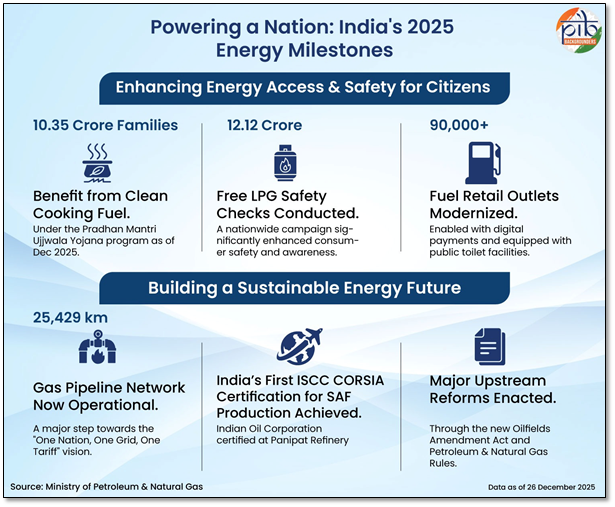
The nationwide fuel retail network expanded from around 52,000 outlets in 2014 to over one lakh by 2025, improving last-mile fuel availability across urban and rural areas.
Cleaner fuel infrastructure witnessed rapid growth, with CNG stations increasing from about 968 to over 8,477 and PNG household connections rising from 25 lakh to over 1.59 crore, supporting cleaner mobility and household energy use.
Under the vision of One Nation, One Gas Grid, the natural gas pipeline network expanded to over 25,400 km, with an additional 10,459 km under construction, enabling pan-India transportation of gas.
The integrated gas grid has supported 100 percent City Gas Distribution (CGD) geographical coverage, strengthening energy security and the transition towards a gas-based economy.
Petroleum Marketing and Electric Mobility Infrastructure:
Petroleum marketing infrastructure was strengthened with over 90,000 retail outlets enabled with digital payment facilities, supported by more than 2.71 lakh POS terminals.
Over 3,200 fuel bowsers were commissioned to expand door-to-door fuel delivery, particularly in remote and underserved areas.
Electric mobility infrastructure expanded with 8,932 EV charging stations installed at retail outlets under Faster Adoption and Manufacturing of (Hybrid &) Electric Vehicles (FAME) Phase-II, along with over 18,500 additional charging stations set up by Oil Marketing Companies.
Logistics and Wayside Amenities:

Over 500 APNA GHAR truckers’ wayside amenities were established to improve road safety, rest facilities, and welfare for logistics workers.
1,064 integrated Energy Stations were commissioned as of 1 November 2025, offering conventional fuels alongside alternative energy options along major transport corridors.
Clean Energy Transition and Low-Carbon Pathways
With energy access and infrastructure expansion providing the physical foundation for India’s energy system, the focus has increasingly shifted towards reducing the carbon intensity of energy use while meeting rising demand. Clean energy transition and low-carbon pathways are therefore central to balancing energy security, economic growth, and climate objectives.
India is advancing its clean energy transition through a diversified approach that combines renewable energy expansion with alternative and low-carbon fuels. The ethanol blending programme has resulted in foreign exchange savings of about ₹1.59 lakh crore, reduction of 813 lakh metric tonnes of CO₂ emissions, and substitution of 270 lakh metric tonnes of crude oil since 2014, reflecting the role of biofuels in reducing import dependence and emissions.
Biofuels form an important bridge between conventional fuels and cleaner energy systems, allowing emission reductions without large-scale changes to existing vehicle and fuel infrastructure. Alongside biofuels, India is scaling up initiatives in green hydrogen, sustainable fuels, and other emerging low-carbon technologies, supported by rapid growth in renewable energy capacity and grid modernisation. These efforts align with India’s Net Zero emissions target for 2070, while ensuring energy security and economic growth.
The National Policy on Biofuels, 2018, as amended in 2022, advanced the target of 20 percent ethanol blending in petrol from 2030 to Ethanol Supply Year (ESY) 2025–26. Under the Ethanol Blended Petrol Programme, average ethanol blending reached 19.05 per cent as on 31 July 2025, with 19.93 per cent achieved in July 2025, indicating steady progress towards the target.
Energy transition outcomes also depend on household-level adoption of cleaner fuels, particularly in cooking, where traditional fuel use has health and environmental implications. Accordingly, access to clean cooking energy has been significantly expanded under the Pradhan Mantri Ujjwala Yojana (PMUY), with the number of beneficiaries reaching about 10.41 crore as of January 2026. To achieve saturation of LPG coverage, the Government has approved the release of 25 lakh additional LPG connections during FY 2025–26, supported by simplification of the eligibility process through a single Deprivation Declaration, making access faster and more inclusive.
Ensuring affordability is critical for sustained adoption of clean cooking fuels beyond initial access. Affordability is being ensured through a targeted subsidy of ₹300 per 14.2 kg cylinder for up to nine refills per year for PMUY beneficiaries. As a result, LPG usage has shown a sustained increase, with average per capita consumption rising from about three refills in 2019–20 to 4.85 refills per annum during FY 2025–26, indicating deeper adoption of clean cooking fuel.
Indian Oil Corporation Limited became the first Indian company to receive International Sustainability and Carbon Certification (ISCC) Carbon Offsetting and Reduction Scheme for International Aviation (CORSIA) certification for SAF production at its Panipat Refinery, followed by an MoU with Air India for SAF supply.
India’s Global Energy Leadership and Future Commitment
As India’s energy transition progresses, engagement with international energy platforms has become important for understanding global market developments, sharing implementation experiences, and contributing to collective responses on energy security and sustainability. As a large and growing energy-consuming economy, India participates in international discussions on energy security, transition pathways, and clean fuels, drawing on lessons from domestic programmes implemented at scale.
India’s participation in platforms such as the Global Biofuel Alliance (GBA) and the G20 Energy Transitions Working Group reflects its emphasis on practical and inclusive approaches to energy transition. These engagements provide opportunities to exchange perspectives on biofuels, alternative fuels, and gas-based systems, and to examine issues related to supply diversification, affordability, and emissions reduction in the context of differing national circumstances.
In addition to formal multilateral forums, India Energy Week serves as an international platform for dialogue among governments, industry, financial institutions, and technology providers. The event supports structured knowledge exchange platforms on energy markets, investment, clean energy technologies, and transition pathways, complementing ongoing international and multilateral engagements.
Together, India’s international participation and forward-looking energy objectives underscore a commitment to cooperative solutions that balance development needs with climate action.
Conclusion
India’s energy landscape has undergone a significant transformation in recent years, supported by policy reforms, infrastructure expansion, and targeted clean energy interventions. Progress across hydrocarbons governance, gas connectivity, fuel and mobility infrastructure, biofuels, and clean cooking has strengthened energy access, improved system resilience, and reduced emissions intensity. These developments reflect a transition approach that emphasises scale, implementation, and inclusion while responding to rising energy demand.
References
Ministry of Petroleum and Natural Gas:
https://www.pib.gov.in/PressReleasePage.aspx?PRID=2209478®=3&lang=1
https://www.indiaenergyweek.com/
https://www.pib.gov.in/PressReleseDetail.aspx?PRID=1896731®=3&lang=1
https://www.pib.gov.in/PressReleseDetail.aspx?PRID=2212948®=6&lang=1
https://www.pib.gov.in/PressReleasePage.aspx?PRID=2096817®=3&lang=2
https://sansad.in/getFile/annex/268/AU2859_W3x2Fj.pdf?source=pqars
https://www.pib.gov.in/PressReleasePage.aspx?PRID=2208694®=3&lang=1
https://www.pib.gov.in/PressReleasePage.aspx?PRID=2211769®=3&lang=2
https://pngrb.gov.in/pdf/press-note/20251216_PR.pdf
https://www.pib.gov.in/PressReleasePage.aspx?PRID=2200386®=3&lang=1
https://www.pib.gov.in/PressReleasePage.aspx?PRID=2155110®=3&lang=2
https://www.pmuy.gov.in/index.aspx
https://www.pib.gov.in/PressReleasePage.aspx?PRID=2208694®=3&lang=1
Ministry of External Affairs:
https://www.mea.gov.in/press-releases.htm?dtl/37092/Launch_of_the_Global_Biofuel_Alliance_GBA
Ministry of Power:
https://powermin.gov.in/en/content/energy-transitions-working-group
Ministry of Information and Broadcasting:
https://www.pib.gov.in/PressReleasePage.aspx?PRID=2094025®=3&lang=2
World Bank:
https://openknowledge.worldbank.org/server/api/core/bitstreams/f983c12d-d43c-4e41-997e-252ec6b87dbd/content
Petroleum and Natural Gas Regulatory Board:
https://www.pngrb.gov.in/pdf/TPIAs/HLC_20241028.pdf
IOCL:
https://iocl.com/NewsDetails/59413
IBEF:
https://www.ibef.org/news/india-to-be-the-world-s-largest-driver-of-energy-demand-growth-by-2035-international-energy-agency-s-iea
Ministry of Heavy Industries:
https://www.pib.gov.in/PressReleaseIframePage.aspx?PRID=1942506®=3&lang=2
NCERT:
https://ncert.nic.in/textbook/pdf/kech203.pdf
India’s Expanding Role in the Global Energy Transition
*****
PIB Research
(Explainer ID: 157098)
आगंतुक पटल : 873
|





