Ashutosh Agnihotri, a distinguished 1999-batch IAS officer, poet and author, has spent over two decades navigating the intersections of governance, literature and civilisational thought. Having served in key leadership roles across public administration while authoring multiple acclaimed works in both Hindi and English, Agnihotri brings a rare blend of administrative insight and literary sensitivity to his writing. His latest book, Sab Par Ram Tapasvi Raja, reimagines the Ramayana through the inner worlds of its characters, exploring timeless questions of duty, compassion, leadership and human consciousness.
In this exclusive interview, Ashutosh Agnihotri reflects on the inspiration behind Sab Par Ram Tapasvi Raja, the enduring relevance of India's civilisational wisdom and how lessons from the Ramayana can inform leadership, governance and personal growth in contemporary times. Drawing from both public service and poetry, he discusses the values that continue to shape India's cultural consciousness and why ancient narratives remain deeply relevant in a rapidly changing world.
Here are edited excerpts:
After decades in public administration, what compelled you to write this book now? Was there a defining moment that convinced you these ideas needed to reach a wider audience?
My interest in literature began in early childhood, when my father introduced me to the works of great writers. I read extensively in both English and Hindi and, through translation, discovered the literature of many other Indian and world languages. Those books gave me a deeper understanding of human nature, relationships and emotions. They refined my sensibility in ways that have stayed with me throughout my life.
Public administration, real and rugged as it may appear, is not bereft of emotion. On the contrary, a civil servant must keep his sensitivity alive if he is to understand people and discharge his responsibilities well. Literature helped me preserve that sensitivity.
I carried this interest with me into the Indian Administrative Service and have continued to write throughout my career. I have now authored ten literary books, five each in English and Hindi. My latest book, Sab Par Ram Tapasvi Raja, is a collection of poems on the characters and episodes of the Ramayana, written from a psychological perspective. I have not altered the story or its narrative. I have only attempted to enter the minds of its characters and imagine their thoughts, dilemmas and responses through metrical poetry. While I have written about Lord Ram in earlier books as well, this work has a much larger canvas and gives voice to several characters who have seldom found such treatment in poetry.
The defining moment came during a conversation with my son. He suggested that I write a poem on the relationship between a father and a son, with Dashrath and Ram as its inspiration. I agreed to write that one poem. I did not know then that he had, in fact, suggested an entire book.
Your book revisits ancient Indian thought through a contemporary lens. What are the three biggest misconceptions modern readers have about India’s civilisational wisdom that you hope to challenge?
The first misconception is that our ancient wisdom is merely mythical or irrational. Certainly, we cannot attribute every modern scientific discovery to our ancient scriptures, nor should we. Our assertions must always rest upon credible evidence. But it is equally unscientific to dismiss everything in our civilisational inheritance simply because it is ancient.
The second misconception is that our traditions deserve respect only after they receive validation from elsewhere. We often seem willing to recognise something Indian only after it has travelled to the West and returned with foreign approval. That, to my mind, reflects not intellectual confidence but intellectual dependence.
The third misconception is that respect for the past is somehow incompatible with a modern outlook. We should certainly remain progressive and forward-looking. But dismissing the past with the arrogance of little knowledge is intellectual shallowness.
I believe that the greatest loss a civilisation suffers is not the loss of memory, but the loss of faith in its own memory.
Many people see ancient philosophy as abstract or spiritual. How can its principles inform leadership, governance, decision-making and institution-building in the twenty-first century?
I belong to a civilisation that has taught me to question and enquire, to embrace and assimilate. Our tradition has never asked us to close the doors of the mind. It has encouraged us to seek wisdom wherever it may be found.
One of our oldest prayers asks that noble thoughts come to us from every direction. That openness has always appealed to me. Every new idea enlarges us. Every sincere enquiry deepens our understanding.
These are not merely spiritual ideals. They are principles of leadership.
Any field of work, and more so, administration, demands humility before complexity, openness to new ideas, respect for diversity and the willingness to listen before deciding. Institutions become stronger when they are guided by duty rather than ego, by inclusion rather than exclusion, and by the recognition that every individual possesses inherent dignity.
I belong to a nation where my faith does not diminish because someone else worships differently. I do not feel threatened if another prays in a language I do not understand. Those voices merely add to the music of the air I breathe.
Ideas such as interconnectedness, acceptance, the unity of existence and the continuity of time have long been part of our civilisational consciousness. Recast in contemporary language, they continue to inform ethical leadership, public service and responsible decision-making.
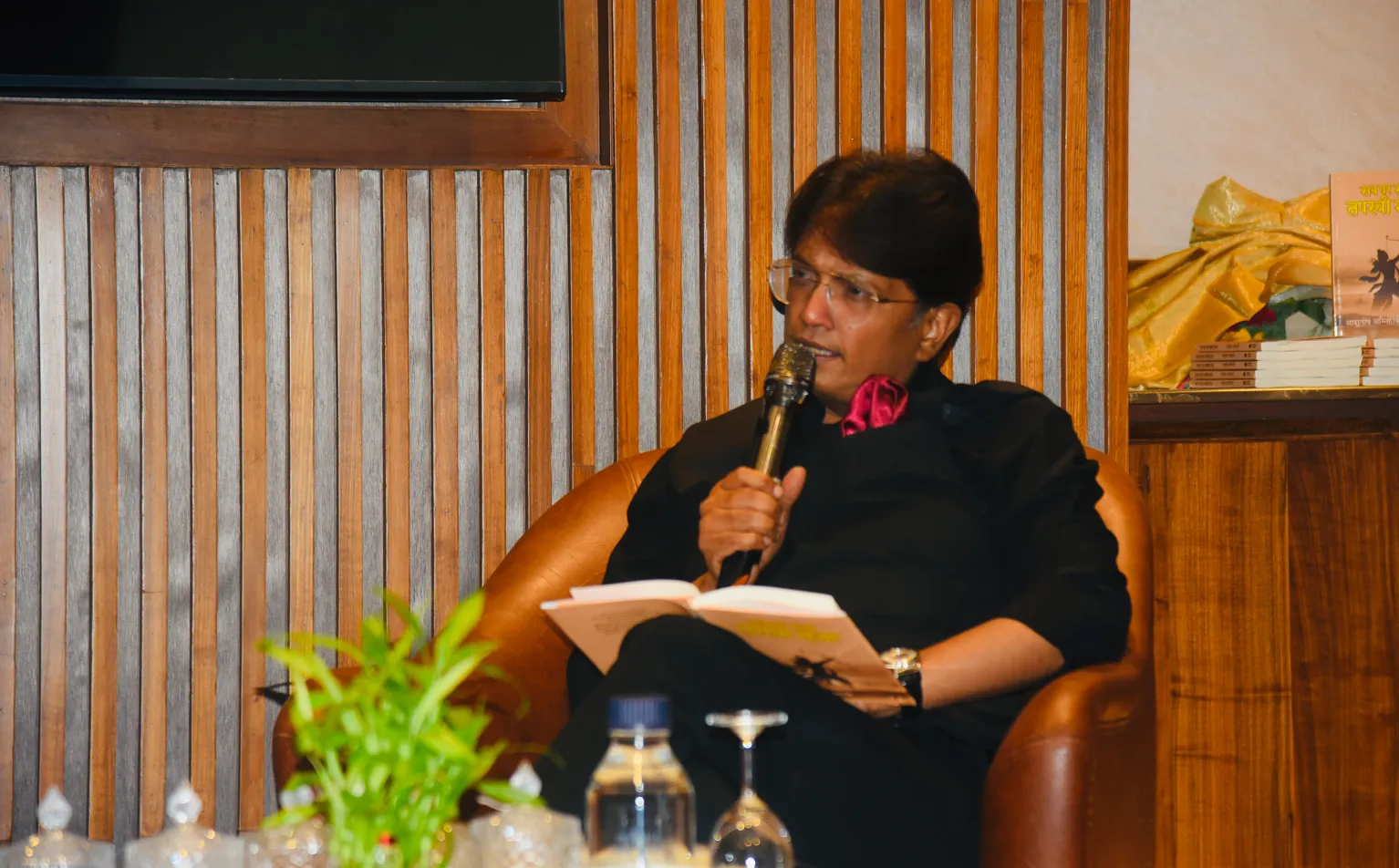 You have balanced a demanding career in the IAS with extensive research and writing. How has your experience in government influenced the way you interpret history and philosophy and vice versa? You have balanced a demanding career in the IAS with extensive research and writing. How has your experience in government influenced the way you interpret history and philosophy and vice versa?
The Indian Administrative Service offers an extraordinarily rich range of human experiences. It introduces one to different regions, cultures and communities, and provides a deep interface with people from every walk of life. Every encounter enlarges one’s understanding of human nature.
As I said earlier, it is important for a civil servant to keep his sensitivity alive. My years in public service enriched my worldview, sharpened my understanding of human behaviour and deepened my appreciation of life’s complexities. Those experiences inevitably find their way into my writing.
Whether I write about the characters of the Ramayana or, in my ongoing work, those of the Mahabharata, I find that the moral conflicts they confront are remarkably similar to those we encounter, in different forms, in public life. The settings have changed; human nature has not. Questions of duty, justice, loyalty, compassion and conscience continue to challenge us, whether in an epic narrative or in the everyday work of governance.
When I reflect upon history, philosophy or the characters of our epics, I do so not merely as a reader but also as someone who has spent decades observing people, institutions and society from close quarters.
The relationship also works in the other direction. Literature and philosophy cultivate empathy, patience and introspection; qualities that are equally valuable in public administration. For me, administration and literature have never travelled on parallel roads. They have always flowed into each other.
India is often described as a rising global power. In your view, what aspects of our civilisational heritage remain underappreciated in shaping India’s economic, cultural and strategic future?
We should take quiet pride in our civilisation. I still remember choosing “India’s Contribution to World Wisdom” as the topic of my essay in the Civil Services Examination. I believed then, and I continue to believe now, that the world’s collective wisdom would have been poorer without India’s contributions to mathematics, science, philosophy, wellness and our understanding of human consciousness.
What remains underappreciated today is not merely our accumulated knowledge but our way of looking at the world. Our civilisation has consistently emphasised harmony over domination, sustainability over exploitation, and duty alongside rights. These ideas are profoundly relevant to the challenges of the twenty-first century.
Much of our inherited wisdom emerged through centuries of careful observation and lived experience. The disciplines governing food, health, daily routine and community life were refined over generations. Not every tradition deserves unquestioning acceptance, but neither does every tradition deserve dismissal.
To reject inherited wisdom without first understanding the experience that shaped it is not rationality. It is misplaced certainty.
If there is one chapter or idea in the book that you believe will surprise readers the most, what is it, and why do you think it is especially relevant today?
I have not attempted anything spectacular, nor do I seek to surprise the reader.
My hope is simply that readers come away with a deeper appreciation of the values, symbols and human relationships embodied in the Ramayana.
Ram became Ram not because he was born in the Raghu dynasty, but because of what he chose to embody; grace, discipline, compassion, honesty and unwavering commitment to dharma. Through different poems, I have tried to illuminate different facets of that personality.
If I were to single out one idea, it would be Sita’s understanding of Ram and of their relationship. Her voice, as I have imagined it, offers a perspective that may answer the doubts some people continue to raise about Ram’s love for her. I hope readers encounter that relationship with fresh eyes.
What is the one message you hope young Indians, future administrators, entrepreneurs and business leaders take away after reading this book?
If there is one idea that lies at the heart of this book, it is this. What we call Shiv is not a distant or inscrutable force seated upon some remote summit. He is not elsewhere. He is here, within us, present in all that breathes, and even in that which does not; in the saint and in the sinner; in Ram and in Ravan alike.
The difference between Ram and Ravan is not that one was given Shiv while the other had denied him. The difference is that one recognised the Shiv within and nurtured him, while the other buried him beneath the weight of his own ego. The seed is the same. Only the soil differs.
It took me many years to realise that this strange and solitary God was never somewhere far away. He was already within me. He is within each one of us.
To recognise him, however, is not easy. Ego stands in the way. So long as one is full of oneself, there is little room for Shiv to reveal himself. The Shiv within lies buried beneath the noise of one’s own importance.
This, to me, is what ultimately separates Ram from Ravan. Both were gifted, learned and immensely capable. Ravan may well have been the greater scholar. Yet he placed himself at the centre of his universe and expected everything else to revolve around him. Ram placed himself at the edge and let the world pass through him.
The Shiv within Ravan was not absent; it was buried. The Shiv within Ram was not exceptional; it was simply allowed to manifest.
If readers carry one thought from this book, I hope it is this: each of us has the capacity to become either Ram or Ravan. The choice lies in whether we nourish the Shiv within or bury him beneath our own ego. |





